
Kinyingarra Guwinyaba (Place of Oyster Rocks): Reflections on the Creative Workshop post the EDAR8 Conference
Posted by Emma Lamb
11 September 2026PhD student, CLIMAR member and EDAR8 presenter Cara Patel reflects on a memorable workshop experience on the Australian island of Minjerribah.
Everyone in our research group works in some way under the umbrella of the environmental dimension of antimicrobial resistance (AMR), and so a conference that we all try to attend is the biennial Environmental Dimension of Antimicrobial Resistance (or EDAR) conference, which this year was held in Brisbane, Australia.
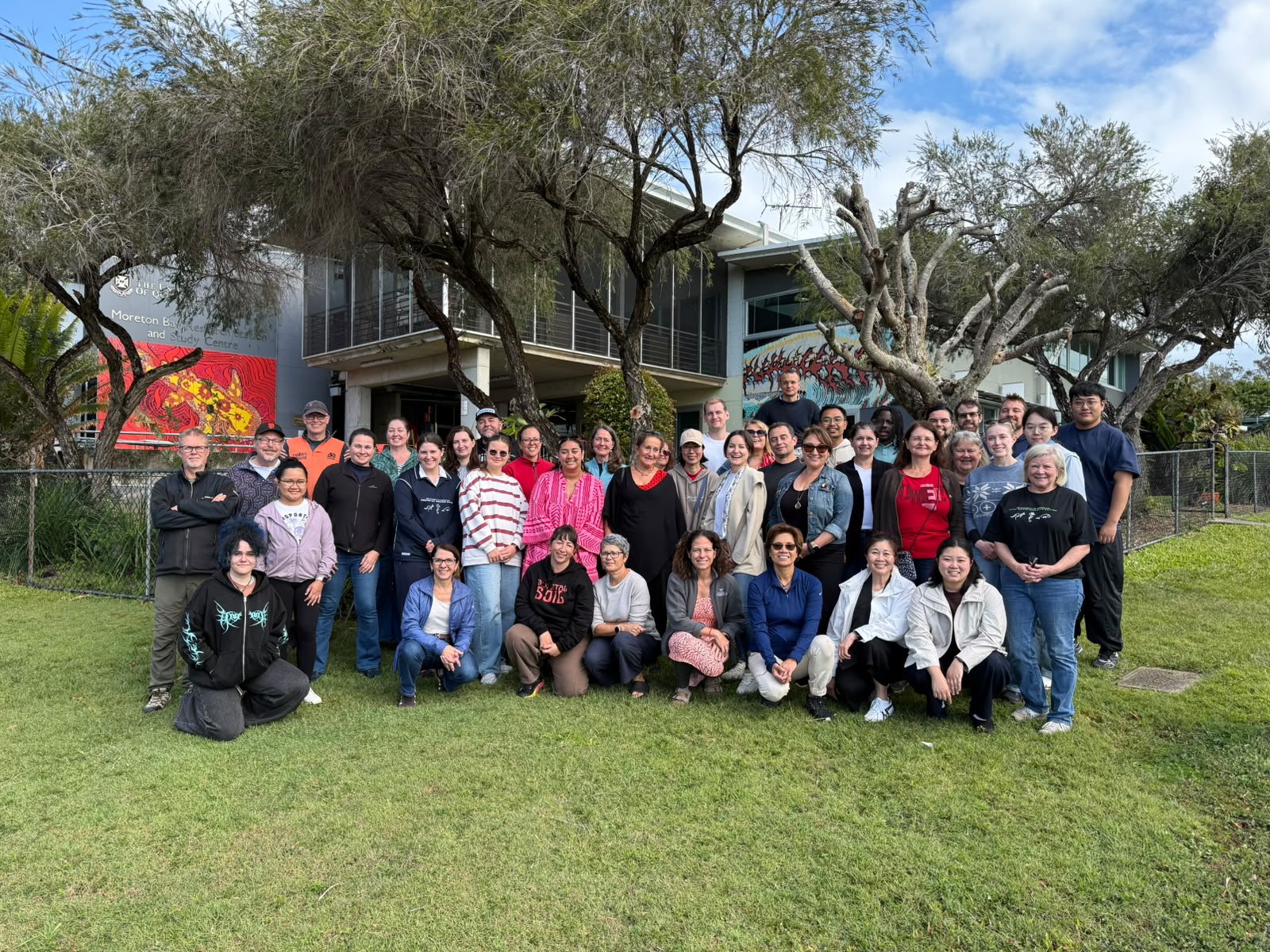
After attending and presenting my PhD work (on the impact of climate change on environmental AMR) at the conference, I had the privilege to participate in a 3-day workshop on North Stradbroke Island (Minjerribah in the native language). This workshop was to bring together traditional teachings of Aboriginal and Torres Strait Islander peoples, creative approaches, and academic knowledge, through participating in the oyster reef restoration project: Kinyingarra Guwinyaba (Place of Oyster Rocks) AMR EDAR8 2026, Megan Cope Collaboration.
We learned that Minjerribah is the Country of the Quandamooka People, who have been the traditional custodians of the island’s land and waters for thousands of years. There are structures on the island important to the First Nations people called middens, and some have been dated to be as old as the pyramids. They are areas where people would gather, eat and shuck shellfish like oysters, and tell stories. Over the years, there accumulated mounds of oyster shells. When the European colonisers arrived, they mined the middens to make cement. Though not as visually impressive as the pyramids, I can hardly imagine mining the pyramids to make building materials.
There’s a Quandamooka artist, Megan Cope, who decided to educate the public on this history through art. and made sculptures of oyster shells cast from cement.
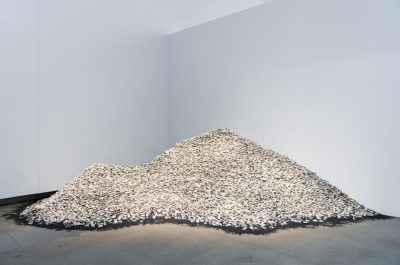
‘Water: A rising tide’ 2016 – Cast-concrete oyster shells, copper slag. 12,000+ pieces. Dimensions variable. Courtesy of Megan Cope and QAGOMA, Brisbane.
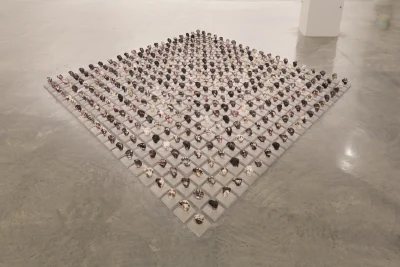
Foundations III 2020 – Oyster shells and cast concrete. 400 pieces. Dimensions variable. Courtesy of Megan Cope and Milani Gallery, Brisbane
Cope then decided that she wanted her art to build towards the future, rather than keep re-hashing a past she couldn’t change. That’s when she came up with the oyster reef project: Kinyingarra Guwinyaba (Place of Oyster Rocks), which are living structures that help new oysters to establish and grow new reefs. Every year since, she and a team make wooden poles from Cyprus Pine, drill holes in them, and make strings of old oyster shells on wire that they then wrap around the pole. The poles are stuck into the sand in the inter tidal zone. The baby oysters then attach themselves to the old shells and the reef can re-grow. These structures exist as art installations in their own right, but have also been displayed in galleries to promote the project and the history.
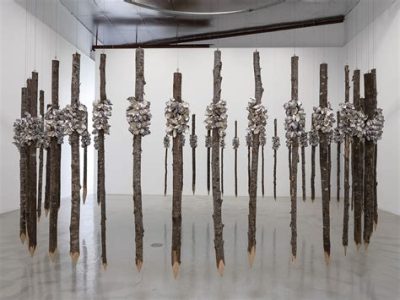
Low Pressure (Milani Gallery, Brisbane, 2022). Image courtesy of Megan Cope and Milani Gallery, Brisbane. Photographer: Carl Warner.
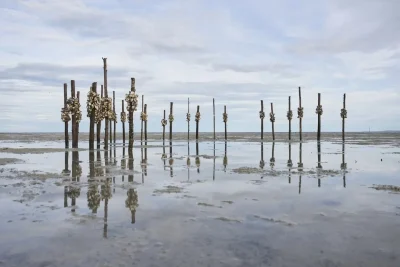
Kinyingarra Guwinyanba by Megan Cope, High Tide (2024). Photographer: Cian Saunders.
During the workshop, we made a set of oyster poles and set them up in the inter-tidal zone, but were also tasked with a reflection exercise.
Following a talk from Professor Pauline Sameshima introducing the concept of “Parallaxic Praxis” (the process of transforming knowledge into something else in order to share it with a new audience), we were given a notebook to note down any reflections we had about the workshop and to answer the following question: What does the relationship between oysters and the other living systems teach us in the research we do?
We were encouraged to think outside the box with the form and structure of our reflections, e.g. song lyrics, drawings, standard prose, etc. Inspired by a discussion with another workshop participant, I decided to go with stream of consciousness poetry. We then came together on the final day to share our reflections, use the process of Parallaxic Praxis in small groups to share our learnings in connection to AMR with the workshop participants, and brainstorm research paper topics that could come from this. I’m interested to see how this develops in the future.
Here are some of my reflections during this exercise:
The joy and creativity in the room were palpable today. It was a living thing you could breathe. We split into small groups to share our reflections, and then small groups paired together to form a performance piece to creatively share what we had taken away.
Our group decided to use song, and I volunteered to perform it. I am no stranger to performing, as I sing in a choir and a barbershop group, I do drag, and I’ve done a number of acting roles. But this was nerves of a different kind. Confronting that I may look silly in front of a room full of people I respect, and doing it anyway. But they reflected that silliness straight back to me. It’s a strange sensation to see one’s supervisor with a piece of paper stuck to his chest labelling him AMR, using interpretive movement.
I feel like we are now all connected through silliness.