

Connecting the Dots: Climate Change and AMR
Posted by Emma Lamb
30 September 2026A CLIMAR member report from the 9th World One Health Congress (WOHC2026), courtesy of Muhammad Asaduzzaman (University of Oslo, Norway), who co-leads CLIMAR’s Movement Building and Systems Change Working Group
WOHC2026 is the flagship biennial event of the global One Health community, held under the patronage of the Quadripartite collaboration on One Health (WHO, FAO, UNEP and WOAH). The four-day programme (4–7 September 2026) combined plenaries, parallel Scientific Sessions and Science–Policy Interface Sessions, thematic workshops, poster sessions and side events, covering climate change, biodiversity, AMR, food systems, biosecurity and One Health governance and education. I attended several sessions covering AMR, biodiversity, wildlife and pathogen interfaces; three thematic workshops; and also presented my work on AMR and food safety.
I attended primarily as a delegate of the BEACON COST Action funded by COST (European Cooperation in Science and Technology). As co-lead of CLIMAR’s Movement Building and Systems Change Working Group, I am sharing my perspectives with the wider CLIMAR membership because almost every AMR session was, implicitly or explicitly, also a session about climate change, land-use change, biodiversity loss or pollution.
This is the strongest possible validation of CLIMAR’s founding premise and of the value of our Working Groups’ systems-based approach.
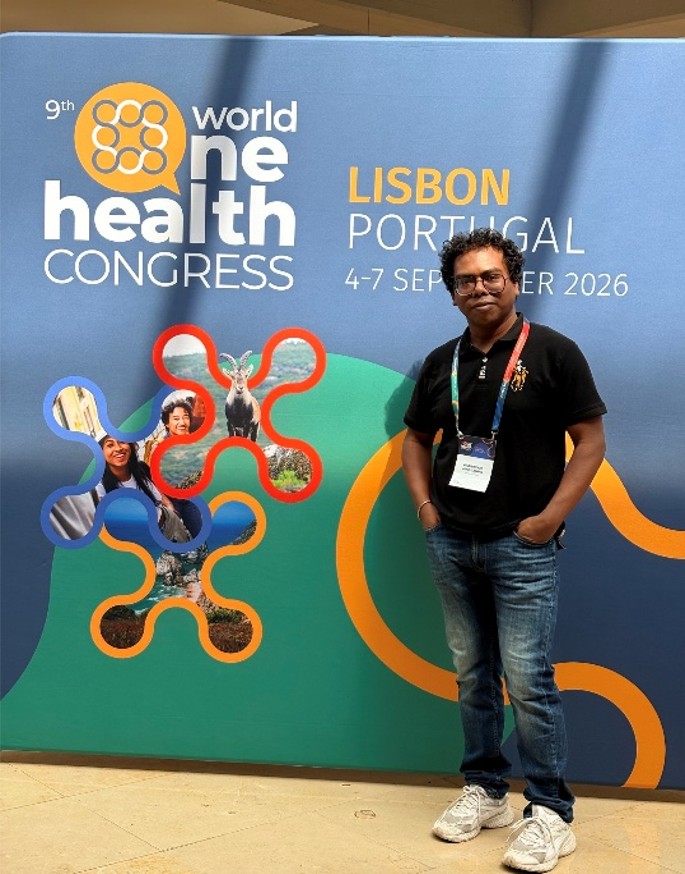
The author at the WOHC2026 venue, Lisbon, Portugal (4–7 September 2026).
The Climate–AMR Interconnection: What the Evidence Showed
For a CLIMAR audience, the most relevant material came from the Biodiversity, Wildlife & Pathogen Interfaces sessions and the Antimicrobial Resistance sessions, which painted a consistent systems picture: climatic and environmental change reshapes where pathogens and resistance genes move, and AMR reservoirs sit within, not outside, the planetary-boundary pressures CLIMAR’s Working Groups are built around.
- Land-use change, biodiversity loss and pathogen/AMR emergence: Several presentations connected habitat disturbance directly to microbial and viral dynamics: deforestation and seasonality were shown to reshape viral diversity in rodent reservoirs (Wildlife Conservation Society), while habitat disturbance was linked to shifting mosquito and virus community composition across tropical ecosystems (Charité, Berlin). A dedicated presentation examined environmental AMR, wildlife and biodiversity in Tunisia explicitly aligned with the Kunming–Montreal Global Biodiversity Framework — a direct, policy-level articulation of the biodiversity–AMR link that CLIMAR’s Biosphere IntegrityBiosphere Integrity and Biogeochemical Flows work could build on.
- Climate-driven species movement and AMR spread: Two independently presented studies tracked antimicrobial resistance genes (including blaCTX-M-15) in migratory birds along the Palearctic–Afrotropical flyway (Karatina University, Kenya). Migratory routes and timing are themselves sensitive to climate change, meaning shifts in bird migration patterns could plausibly alter the geography of AMR gene spread which is a clear illustration of how a Planetary Boundary process (climate change) can act as a vector for a Planetary Health outcome as AMR.
- Pollution, disasters and environmental AMR reservoirs: A study of the aftermath of a mining-related dam disaster in Brazil’s Paraopeba River Basin demonstrated how a single pollution event can create lasting environmental and clinical AMR signals. This is a vivid case study for CLIMAR’s Novel EntitiesNovel Entities and Freshwater Change Working Groups. Wastewater-based surveillance work in sub-Saharan Africa similarly showed how AMR and tuberculosis signals can be tracked through environmental (water) systems rather than only through clinical data.
- Food systems, aquaculture and climate-sensitive AMR governance:A comparative governance analysis of AMR drivers in aquaculture in Canada and Norway, and a study evaluating reduced colistin use in Indonesian livestock and poultry (the COINCIDE study), both showed how climate-exposed food-production systems shape antimicrobial use pressure. FAO’s International Antimicrobial Resistance Monitoring System (InFARM) was presented as an emerging tool for monitoring these dynamics globally across animal populations and food systems.
Takeaway for CLIMAR: The evidence at WOHC2026 supports treating AMR as a downstream indicator of multiple Planetary Boundaries under stress simultaneously such as land-system change, biosphere integrity, freshwater change and novel entities (pollution), all surfaced as AMR drivers in the same two days of sessions. This strengthens the case for CLIMAR’s cross-Working-Group, transdisciplinary model rather than siloed AMR-only research.
A Systems-Thinking and Movement-Building Lens on the Workshops
Beyond the scientific evidence, three workshops offered concrete tools and models directly relevant to our Working Group mandate of translating systems thinking into collective action.
- The One Health Mural — a systems-mapping tool: Facilitated by Florence Ayral and Alexis Peutot (VetAgro Sup), this workshop used a large-scale collaborative mural exercise to help a mixed group of researchers, policymakers and practitioners visualise systemic interactions between human, animal and environmental health drivers in real time. For CLIMAR, this is a directly transferable facilitation method: a low-cost, visual, participatory way to make the interconnections between climate change, biodiversity and AMR tangible to non-specialist audiences — exactly the kind of ‘movement building’ tool our Working Group could pilot at a CLIMAR members’ meeting or public engagement event.
- One Health Biosecurity on Islands — bounded systems as case studies: Chaired by Katey Pelican (University of Hawaii) and Jamechia Hoyle (LMI), this workshop examined island and archipelago settings as geographically bounded systems where biosecurity vulnerabilities including climate-linked ones such as sea-level rise and extreme weather, are easier to observe and model than in open, continental systems. Pelican’s role in establishing the Southeast Asia One Health University Network (SEAOHUN) is itself an example of how a bounded regional case can seed a much larger network — a pattern CLIMAR’s own regional working-group structure could learn from.
- Transformative One Health Training — competencies for systems-capable practitioners: Chaired by Cécile Aenishaenslin (Université de Montréal) and Nicolas Antoine-Moussiaux (University of Liège), with contributions from the Royal Veterinary College, Afrique One, Canopy (Canada) and York University, this workshop discussed updated One Health core competencies, competency-based pedagogy, and Indigenous perspectives on One Health education. The competency frameworks discussed are a useful reference for CLIMAR if our Working Group moves toward formal training or capacity-building products aimed at equipping the next generation of practitioners with systems-thinking skills for climate–AMR problems.
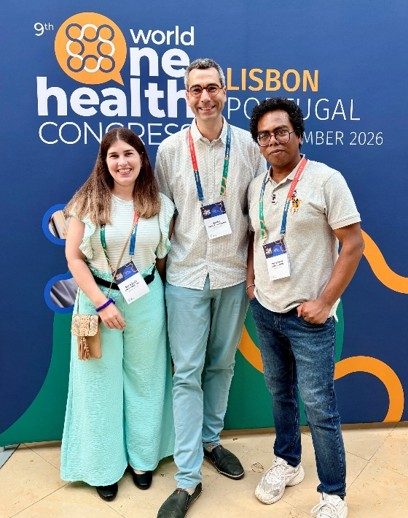
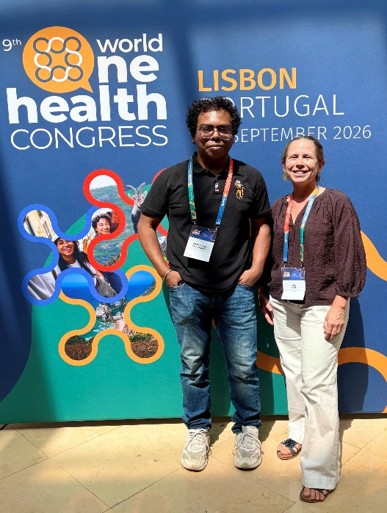
Left: with Maria (University of Almeria) and Nicolas Antoine-Moussiaux (University of Liege) after the Transformative Training workshop. Right: with Prof. Kelly Baker, University at Buffalo.
Major Takeaways for CLIMAR Members
- AMR is a systems outcome, not a stand-alone problem. Across both AMR sessions and both biodiversity/wildlife sessions, resistance emergence and spread were consistently linked to land-use change, biodiversity loss, pollution events and climate-sensitive food systems — reinforcing CLIMAR’s core premise that AMR must be tackled at the intersection of multiple Planetary Boundaries.
- Climate-sensitive species movement (e.g., bird migration) is an under-appreciated AMR transmission pathway, with direct relevance to CLIMAR’s Biosphere Integrity and Interconnection within Nature Working Groups.
- Pollution and environmental disasters (e.g., the Paraopeba mining disaster) can create durable AMR reservoirs, relevant to the Novel Entities and Freshwater Change Working Groups.
- Practical systems-thinking tools exist and are ready to use. The One Health Mural is a facilitation method CLIMAR could adopt for stakeholder workshops or public engagement, in direct support of the Movement Building and Systems Change Working GroupMovement Building and Systems Change‘s remit.
- Bounded regional case studies and networks (e.g., Canopy, island biosecurity, BEACON) can be effective seeds for larger networks and worth considering for CLIMAR’s own regional expansion strategy.
- There is an emerging global policy architecture around AMR-biodiversity-climate linkages (the revised African Union AMR Framework 2026–2030, alignment with the Kunming–Montreal Global Biodiversity Framework, FAO’s InFARM) that CLIMAR should track and, where relevant, feed into via policy engagement.
- Cross-Action collaboration is active and growing: I am connected directly with the chair of CA25122 – Systems Thinking for One Health Implementation (SystOHm), a COST Action with an explicit systems-thinking mandate closely aligned with our own Working Group’s focus, opening a concrete route for future joint activities.
Conclusion
WOHC2026 offered strong, recent evidence that antimicrobial resistance cannot be understood or addressed in isolation from climate change, biodiversity loss, pollution and land-use change — precisely the interconnected view that CLIMAR was created to advance. As Co-Lead of the Movement Building and Systems Change Working Group, I see clear, actionable opportunities for CLIMAR to build on this evidence, adopt practical systems-thinking tools, and deepen collaboration with aligned networks such as CA25122 SystOHm.