

Planetary Health Check 2026: AMR and the Planetary Boundaries
Posted by Emma Lamb
5 October 2026This blog post about the 2026 Planetary Health Check has been put together by CLIMAR co-lead Jennifer Cole | jennifer.cole@rhul.ac.uk
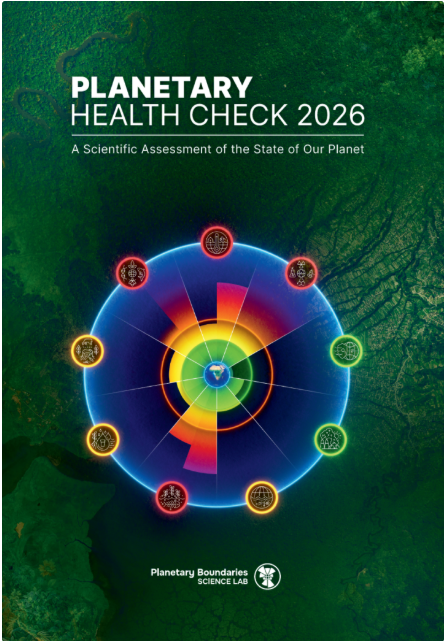
The 2026 Planetary Health Check Report, by the Planetary Boundaries Science Lab.
The annual Planetary Health Check, produced by the Planetary Boundaries Science Lab at the Potsdam Institute for Climate Impact Research (PIK), reports on the current state of our planet. It’s an annual reminder of how close we are to transgressing, or in most cases have transgressed, the Planetary Boundaries, the domains of Earth System processes that provide safe or unsafe operating space for human life. The annual report provides a scientifically robust assessment of risks, actions needed to address them and potential solutions. It’s intended for use by policymakers, business leaders, the media and the public, far beyond those of us working in the academic field of planetary health. A key paradigm that CLIMAR seeks to highlight and evidence – that everything is interconnected – continues to be underlined and stressed by these annual reports.
The Planetary Health Check highlights and reiterates that while each of Planetary Boundaries represents its own risks when transgressed, no single boundary can be considered in isolation. Humans live in complex, constantly shifting socio- and ecological complex adaptive systems that need to be considered holistically. Equally important are the Socioeconomic Trends that shape social environments and determine who can and will take action, as this recent WHO report has highlighted and CLIMAR’s Equity and Social Justice Working Group addresses.
The Planetary Health Check is a key resource for CLIMAR and its members; from our very formation, our network has adopted a planetary health framing to highlighting the challenges of Antimicrobial Resistance (AMR), aiming to draw out and make (more) visible the connections between, for example: antibiotics used in farming (considered under Land Use Change), which increase the abundance of antimicrobial resistance genes (ARGs – Novel Entities) in surface water ecosystems, wastewater and rivers (Freshwater Systems). These three boundaries cannot be addressed from silos.
CLIMAR commends the 2026 Planetary Health Check for updating the supporting data to the section on Novel Entities, which has replaced antibiotic production data with data on prevalence of antibiotic resistance. This is a subtle but important change: while the production and use of antibiotics present a risk of AMR emergence, data on that resistance provide evidence of actual harm. This moves prudent antibiotic stewardship beyond a precautionary principle to proof that action is needed now: the new graph on page 102 shows the shocking exponential rise of AMR impact since 2000, a faster rate of growth than for any other substance considered under the Novel Entities boundary. Throughout the report the interconnection and indivisibility of the boundary domains are explicit.
The report provides a strong reality check for everyone working on AMR, with an overview of key evidence, clear data visualizations and messages to take forward when advocating for the importance of foregrounding AMR in wider discussions on the triple planetary crisis. Only by working across these boundaries will we be able to tackle the impacts on the planet and our health.